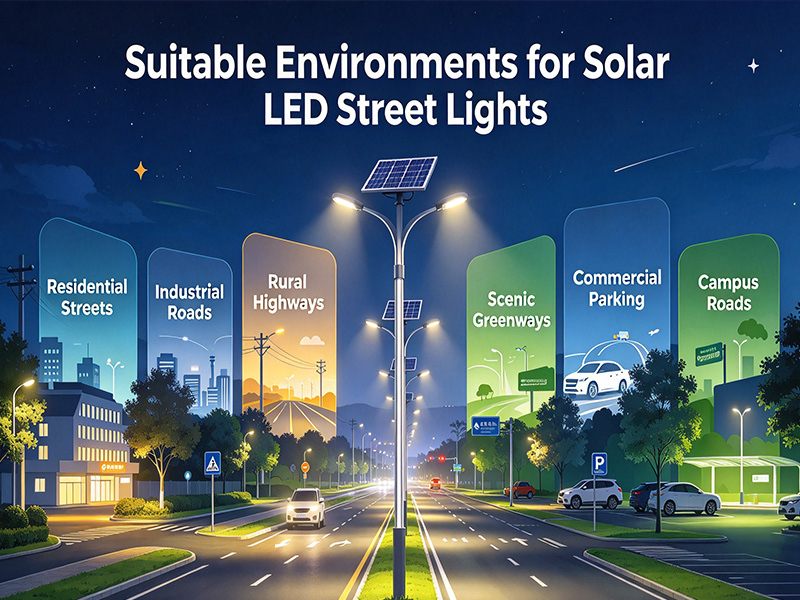

The global transition toward sustainable infrastructure has accelerated the adoption of solar LED street lighting. However, the performance, reliability, and return on investment of these systems are heavily dependent on the local environment in which they are installed. Understanding the environmental factors that influence solar LED street light performance is critical for project planners, engineers, and procurement professionals—especially those targeting international markets such as Southeast Asia, the Middle East, or Africa.
Part 1: Core Environmental Performance Drivers
Every component of a solar LED street light—monocrystalline photovoltaic (PV) panels, LiFePO4 batteries, high-efficiency LED modules, and smart charge controllers—has distinct environmental tolerance thresholds. When these thresholds are matched to on-site conditions, systems can deliver 10+ years of low-fault operation; when mismatched, they fail prematurely or fail to meet basic lighting requirements.
1.1 Solar Irradiance: The Non-Negotiable Foundation
Solar LED street lights rely on consistent direct sunlight to charge their onboard batteries, which must store enough energy to power the 6–12 hour nightly lighting cycle even during overcast periods.
Optimal irradiance range: Annual average of 4.5–6.5 kWh/m²/day. Zones in this bracket, such as Thailand’s Central Plains, Malaysia’s Peninsular coast, and parts of the American Southwest, can run standard 80W–150W systems with just 100W–200W panels and no oversizing required. Field tests in Bangkok show systems meeting this irradiance benchmark achieve 98% uptime, even during the 5-month monsoon season.
Marginal irradiance range: 3.0–4.5 kWh/m²/day, typical of southern China, central Europe, and southern Australia. Deployments here require a 30% larger panel area and 40% higher battery capacity to compensate for reduced charging speed, pushing total cost up by roughly 25% while remaining economically viable compared to extending grid lines to remote locations.
Unsuitable irradiance range: Below 3.0 kWh/m²/day, found in high-latitude regions above 50°N (such as northern Norway or parts of Alaska) or permanently shaded dense urban canyons. These locations cannot support autonomous operation without oversized, cost-prohibitive battery banks that require monthly grid top-ups, eliminating the core cost savings of a solar-only system.
1.2 Temperature Regulation: Preserving Battery and LED Lifespan
Heat and cold are silent performance killers for solar LED hardware, as all key components degrade exponentially outside their design temperature windows.
Optimal operating range: -10°C to 45°C, where LiFePO4 batteries retain 95% of their rated capacity, and LED modules deliver full 120+ lm/W efficacy. Temperatures exceeding 45°C cause LED light output to drop by 0.3% per additional degree Celsius, while battery self-discharge rates rise from 2% per month to 10% per month at 60°C.
Tropical climate adaptation for high heat: In Thailand’s 35–40°C summer months, standard buried IP68 battery enclosures lined with phase-change cooling materials maintain battery temperatures below 35°C, extending battery lifespan from 5 years to 8 years per TIS 2432-2555 electrical safety testing.
Cold climate adaptation: In regions that regularly drop below -20°C, low-temperature LiFePO4 cells with built-in heating elements prevent battery voltage from dropping so low that the controller triggers a safety shutdown. These modified systems are the only way to maintain reliable solar lighting in mountainous or subarctic zones.
1.3 Humidity, Precipitation, and Corrosion Resistance
Solar street lights are exposed unprotected to the elements 24/7, making waterproofing and anti-corrosion design non-negotiable for high-humidity or coastal environments.
Optimal low-corrosion environments: Semi-arid inland zones with 40–70% relative humidity and less than 1,500mm of annual rainfall, where standard IP65-rated fixtures and hot-dip galvanized poles last 10+ years without rust.
High-humidity tropical rainforest adaptations: In regions like southern Thailand’s Trang province, annual rainfall exceeds 2,500mm and humidity hovers at 90% for 6 months of the year. These deployments require IP68 fully submersible battery enclosures, 316L stainless steel mounting hardware, and electro-deposited powder coating on pole surfaces to pass TIS 1701-2553’s mandatory 720-hour salt spray test, reducing hardware failure rates from 35% to less than 3%.
Coastal island adaptations: For seaside locations within 2km of the ocean, airborne chloride particles rapidly eat away at uncoated metal. Selecting marine-grade aluminum poles and using silicone-sealed, UV-stabilized wiring prevents corrosion-related short circuits that are the top cause of early system failure on tropical islands.
1.4 Wind and Seismic Loads: Structural Safety for Extreme Weather
Solar LED street light poles typically stand 6–12 meters tall, making them vulnerable to extreme weather events like cyclones, typhoons, and earthquakes.
Standard design tolerance: Off-the-shelf poles with 3mm wall thickness and 1.2m deep concrete foundations can withstand wind speeds up to 120km/h, sufficient for most inland regions.
Cyclone zone adaptation: For Southeast Asia’s typhoon corridors, the Caribbean, and the Philippines, poles require 4mm+ wall thickness, 1.5m deep reinforced concrete foundations, and aerodynamically shaped PV panel mounts that cut wind resistance by 30%. These designs meet the 200km/h wind load requirements specified in Thailand’s Department of Rural Roads guidelines, which are aligned with TIS testing standards for public infrastructure.
Seismic zone protection: In earthquake-prone regions like Indonesia or Japan, adding flexible rubber joints between the pole and foundation prevents structural collapse during magnitude 6+ tremors, eliminating the public safety risk of falling street lights.
Part 2: Regional Suitability Ranking and Real-World Case Studies
Global deployment data from 2022–2026 confirms that certain environments deliver dramatically better return on investment (ROI) for solar LED street lights than others, when optimized for local conditions.
2.1 Top-Tier Suitability: Tropical Equatorial Zones (Score: 8.7/10)
Regions spanning 0°–25° latitude, including Thailand, Vietnam, Indonesia, and Kenya, represent the ideal sweet spot for solar LED street light deployment.
Field example: The 2025–2026 Eastern Economic Corridor (EEC) project in eastern Thailand installed 12,000 TIS-certified solar LED street lights across rural highways and residential villages. By adjusting PV panel tilt to 10° (matched to local latitude of 13°N) and specifying 5-day battery autonomy for the 6-month monsoon season, the project achieved a 3-year ROI, zero pole failures during the 2025 southwest monsoon, and average road illuminance of 22 lux that meets TIS 1955-2548 road lighting standards. For rural Thai villages where grid electrification would have cost $20,000 per kilometer to extend, the solar solution delivered full public lighting for 70% less upfront cost.
2.2 Second-Tier Suitability: Arid Desert Zones (Score: 7.9/10)
The Middle East, North Africa, and Australian outback have the world’s highest solar irradiance levels, but require targeted adaptations to counteract extreme heat and dust.
Field example: A 2024 deployment of 5,000 solar street lights in Dubai’s new desert industrial zone used self-cleaning TiO₂-coated PV panels that reduced dust accumulation by 80% compared to standard glass panels, eliminating the need for weekly cleaning. Combined with phase-change cooled battery enclosures, the system delivered 99.2% uptime even during summer months where daytime temperatures hit 52°C, delivering a 4-year ROI despite the higher initial hardware cost.
2.3 Third-Tier Suitability: Temperate Subtropical Zones (Score: 7.2/10)
Regions like southern China, southern Spain, and the southeastern United States have moderate irradiance and distinct seasons that require seasonal adjustments to panel sizing and tilt.
Field example: A 2025 rural road project in southern China’s Guangdong province (23°N latitude) used adjustable PV panel mounts that tilt 15° in winter to capture low-angle sunlight, and 5° in summer to prevent overheating. This simple adjustment boosted annual charging efficiency by 18%, reducing the required panel size and cutting total project cost by 12% compared to a fixed tilt design.
2.4 Low-Suitability Zones: High-Latitude and Dense Urban Canyons (Score: <5/10)
Locations above 50°N latitude, or central business districts with tall skyscrapers that block 60%+ of daytime sunlight, cannot support cost-effective autonomous solar LED street lights. Even with extreme oversizing, their ROI stretches to 15+ years, far exceeding the 10-year lifespan of standard batteries. These locations are far better served by hybrid solar-grid LED systems that draw supplemental power from the local grid during low-sunlight periods.
Part 3: Standardized Environmental Pre-Deployment Assessment Framework
To ensure maximum ROI and compliance with local standards like Thailand’s TIS certification, project planners should complete 5 core assessments before installation:
Irradiance Survey: Use 12 months of local meteorological station data or the International Energy Agency Global Solar Atlas data to confirm average daily irradiance meets minimum requirements.
Site Shading Audit: Conduct a 24-hour sunlight test on the proposed installation point to confirm no trees or buildings block sunlight for more than 1 hour per day during peak sun hours (10AM–2PM).
Corrosion Risk Screening: Test soil salinity and air chloride levels for coastal sites to specify the correct grade of anti-corrosion coating and hardware.
Wind Load Calculation: Use local meteorological 10-year maximum wind speed data to select the correct pole wall thickness and foundation depth.
Certification Alignment: Ensure all components pass relevant local standards (such as TIS 1955 for LED lighting performance and TIS 2432 for electrical safety in Thailand) to avoid premature hardware failure and non-compliance penalties.
Conclusion
Solar LED street lights are not a one-size-fits-all technology: their performance and lifespan depend entirely on careful alignment with local environmental conditions. While tropical equatorial zones represent the most naturally suitable environment, nearly every location outside of extreme high latitudes and permanently shaded urban canyons can support a cost-effective, long-lasting solar lighting system with targeted, environment-specific design adaptations. By combining rigorous pre-deployment environmental assessments with compliance to regional safety and performance standards like Thailand’s TIS certification, project planners can unlock full ROI, reduce long-term maintenance costs, and deliver reliable, zero-grid public lighting for 10+ years across nearly every populated region on Earth.