
Introduction
The LED driver is often called the heart of an LED lighting system. It converts AC power into the low-voltage DC power that LEDs need, while regulating current and voltage to ensure stable, efficient, and long-lasting operation.
Choosing the wrong driver can lead to flickering, reduced lifespan, or even permanent damage to the LEDs.
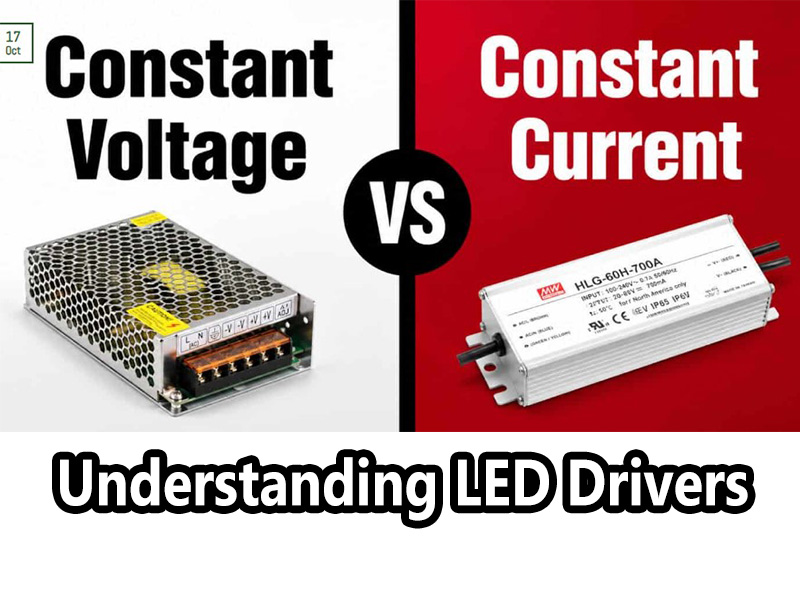
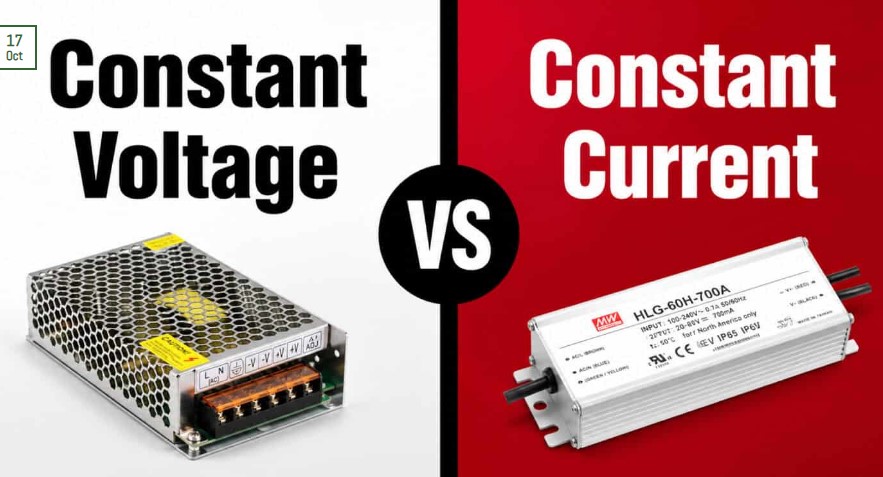
There are two main types of LED drivers: Constant Current (CC) and Constant Voltage (CV). This guide explains how they work, their differences, and how to choose the right one for your lighting project.
1. Constant Current (CC) Drivers
Working Principle:
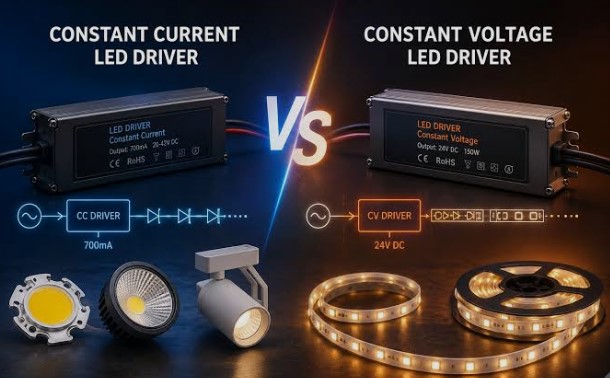
A Constant Current driver maintains a fixed output current (e.g., 350mA, 700mA, or 1050mA), while the output voltage varies automatically to match the LED load’s forward voltage.
Because LEDs are current-driven devices, their brightness is directly proportional to the current flowing through them. A CC driver ensures that each LED receives the exact current it needs — regardless of temperature changes or slight voltage variations.
Key Features:
✅ Stable and precise brightness control
✅ Prevents thermal runaway and protects LED lifespan
✅ High efficiency, ideal for high-power LEDs
✅ Perfect for series-connected LED strings
❌ Must be matched to the specific LED load
❌ Less flexible if you want to change the number of LEDs later
Best for: High bay lights, street lights, spotlights, downlights, and other high-power LED fixtures.
2. Constant Voltage (CV) Drivers
Working Principle:
A Constant Voltage driver provides a fixed output voltage (e.g., 12V DC or 24V DC), while the output current varies depending on the load connected to it.
This type of driver is used with LED products that already have built-in current-limiting components, such as resistors or micro-drivers. Common examples include LED strips and some LED modules.
Key Features:
✅ Flexible — easy to add or remove LED loads
✅ Simple replacement and parallel connection
✅ Cost-effective for low-power applications
❌ Less precise current control
❌ Not suitable for high-power LEDs without additional regulation
❌ Brightness may vary slightly with load changes
Best for: LED strips, signage, landscape lighting, under-cabinet lights, and decorative lighting.
3. CC vs. CV — At a Glance
|
Feature |
Constant Current (CC) |
Constant Voltage (CV) |
|
Output |
Fixed current, variable voltage |
Fixed voltage, variable current |
|
LED Type |
High-power LEDs, series strings |
LED strips, modules with built-in regulation |
|
Brightness Stability |
Excellent |
Good, but depends on load |
|
Efficiency |
High |
Moderate |
|
Flexibility |
Low — must match LED load |
High — easy to expand or replace |
|
Protection |
Prevents thermal runaway |
Requires additional current limiting |
|
Typical Applications |
Street lights, high bays, downlights |
LED strips, signage, landscape lighting |
|
Cost |
Moderate to high |
Low to moderate |
4. How to Choose the Right LED Driver
Consider these factors before selecting a driver:
1. Know Your LED Load
If your LED fixture uses high-power LEDs without internal current regulation, choose a Constant Current driver.
If your LED product is rated for 12V or 24V DC (e.g., LED strips), choose a Constant Voltage driver.
2. Match the Power Rating
The driver’s output power should be at least 10–20% higher than the LED load’s total power to ensure reliability and headroom.
3. Check Dimming Compatibility
If you need dimming, choose a driver that supports 0–10V, DALI, TRIAC, or PWM dimming as required.
4. Consider the Environment
For outdoor or harsh environments, select drivers with appropriate IP ratings and wide temperature tolerance.
5. Prioritize Efficiency and Safety
Look for drivers with high power factor (PF > 0.9) , low THD, and relevant certifications (CE, UL, RoHS).
6. MasonLED Recommendation
At www.masonleds.com, we design and supply LED lighting fixtures with matched drivers to ensure optimal performance, safety, and lifespan.
For high-power outdoor and industrial fixtures → we use Constant Current drivers for precise current control.
For decorative, signage, and strip lighting → we use Constant Voltage drivers for flexibility and easy installation.
If you are unsure which driver is right for your project, our technical team can help you select the best match.
👉 Visit us: www.masonleds.com for more information or to discuss your LED lighting requirements.
Conclusion
LED drivers are not one-size-fits-all. Understanding the difference between Constant Current and Constant Voltage drivers helps you:
Improve LED performance and lifespan
Avoid flickering and premature failure
Choose the most efficient and cost-effective solution
Whether you need a driver for a high-power street light or a flexible LED strip, choosing the right type is essential for reliable, long-term operation.
MasonLED — Professional LED Lighting Manufacturer
🌐 www.masonleds.com