
Introduction
The controller is the brain of any solar street light system. It manages the flow of energy from the solar panel to the battery, ensuring efficient charging and protecting the battery from overcharging and deep discharge.
When choosing a solar street light, you‘ll encounter two main types of controllers: PWM (Pulse Width Modulation) and MPPT (Maximum Power Point Tracking) . Understanding how they work and their differences is essential for selecting the right solution for your project.
1. PWM Controller — Pulse Width Modulation
Working Principle:
PWM is a simpler, more traditional charging technology. It works by matching the output voltage of the solar panel to the nominal voltage of the battery (e.g., a 12V panel to a 12V battery).
When the battery approaches full charge, the controller uses rapid “on/off” pulses to reduce the charging current and maintain a steady voltage, preventing overcharging. This is a passive charging system—it cannot adjust to changes in the solar panel‘s output caused by cloud cover, shade, or temperature.
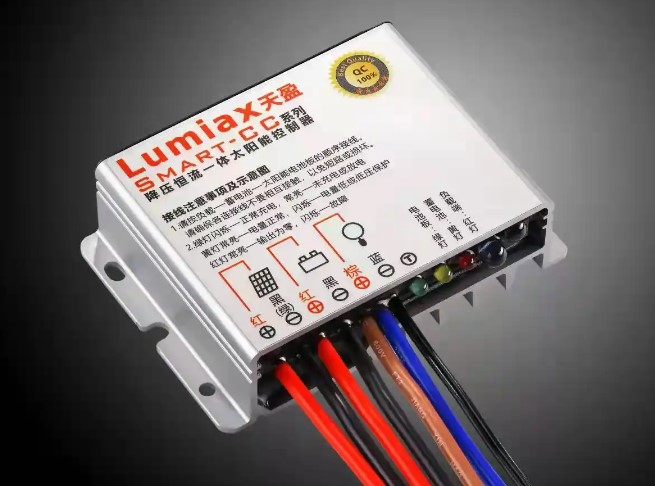
PWM controller
Key Features:
✅ Low cost — significantly cheaper than MPPT controllers
✅ Simple and reliable design with fewer components
✅ Best for smaller systems with matching voltages
❌ Lower efficiency — typically operates at 70–80%
❌ Cannot harvest excess voltage; extra solar energy is wasted as heat
❌ Performs poorly in cloudy or low-light conditions
Best for: Small-scale projects, budget-constrained installations, and regions with consistent, strong sunlight.
2. MPPT Controller — Maximum Power Point Tracking
Working Principle:
MPPT is an advanced, active charging technology. It continuously scans and tracks the maximum power point (MPP) of the solar panel in real time, adjusting for sunlight intensity, temperature, shade, and battery charge level.
The controller uses a DC-DC converter to transform the panel‘s variable voltage into the optimal power for the battery. For example, a 12V solar panel may output 18–22V in full sun; the MPPT controller steps this down to the battery’s charging voltage (13.6–14.4V) while retaining all the available power.
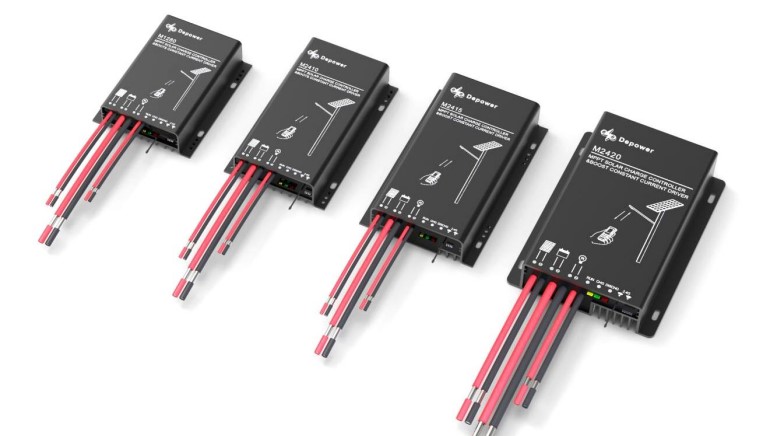
MPPT controller
Key Features:
✅ High efficiency — typically 90–98%
✅ Harvests 20–30% more energy than PWM, especially in cloudy or low-light conditions
✅ Adapts to varying weather and temperature
✅ Supports higher PV voltage, allowing more flexible panel configurations
✅ Advanced battery protection — ideal for lithium and LiFePO₄ batteries
❌ Higher upfront cost
Best for: High-power systems, all-in-one solar street lights, off-grid installations in variable light conditions, and projects where long-term energy efficiency is a priority
MPPT vs. PWM — At a Glance
|
Feature |
PWM Controller |
MPPT Controller |
|
Charging Efficiency |
70–80% |
90–98% |
|
Energy Harvest Gain |
Baseline |
+20–30% more |
|
Cost |
Low (30–50% cheaper) |
Higher |
|
Weather Adaptability |
Poor in cloudy conditions |
Excellent in all conditions |
|
Voltage Matching |
Strict match required |
Flexible — handles higher PV voltage |
|
Battery Protection |
Basic |
Advanced (ideal for lithium batteries) |
|
Best For |
Small systems, consistent sunlight, tight budgets |
High-power systems, variable weather, long-term ROI |
How to Choose the Right Controller for Your Solar Street Light?
Consider these factors:
1.System Power Rating
* For systems under 30W, PWM may be sufficient.
* For systems over 30W, especially high-power street lights, MPPT is strongly recommended.
2.Local Weather Conditions
*If your region has frequent cloudy or rainy days, MPPT will significantly outperform PWM.
* In areas with consistent, strong sunshine, PWM can be a cost-effective choice.
3.Battery Type
For lithium and LiFePO₄ batteries, MPPT offers more precise control and is strongly recommended.
4.Budget vs. Long-Term Value
* PWM has a lower upfront cost but delivers less energy.
* MPPT costs more initially but pays off through higher efficiency, longer battery life, and better performance in adverse weather.
5.System Complexity
*PWM requires strict voltage matching between panels and batteries.
*MPPT allows more flexibility in panel configuration and supports higher PV voltages
Mason LEDs Recommendation
At www.masonleds.com, we recommend:
PWM controllers for small-scale, budget-conscious solar lighting projects in regions with abundant sunshine.
MPPT controllers for most modern solar street light applications — especially high-power, all-in-one, and off-grid systems where reliability and efficiency are critical.
Investing in the right controller ensures your solar street lights deliver consistent performance, extended battery life, and maximum energy savings over their lifetime.
Need help selecting the right controller for your solar lighting project? Contact the Mason LEDs team for expert guidance and ready-to-use solar lighting solutions.
👉 Visit us: www.masonleds.com