
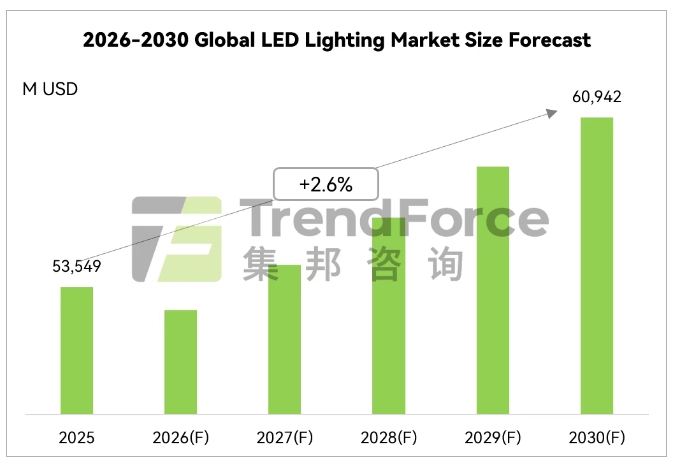
According to the latest 2026 Global LED Lighting Market Trends – Database and Manufacturer Strategies (2H26) report released by TrendForce, the global LED lighting market demand remains in an adjustment phase in the short term, due to sluggish macroeconomic recovery, geopolitical conflicts, and conservative corporate capital expenditure. Growth momentum in the three core markets of Europe, the Americas, and China is limited. However, driven by global energy efficiency regulations, energy-saving retrofits, and net-zero emission (ESG) goals, lighting manufacturers are accelerating their shift away from traditional price competition and actively moving toward high-value-added segments such as smart lighting and specialized professional applications. This transformation is pushing the industry from “volume expansion” toward “product structure upgrade and application value enhancement.” TrendForce projects that the global general LED lighting market will reach USD 60.942 billion by 2030, with a CAGR of 2.6% from 2025 to 2030.
1. Long-term upgrade momentum for general LED lighting remains strong; emerging markets show growth vitality
In the short term, the three core markets of Europe, the Americas, and China are still weighed down by weak commercial real estate and subdued capital expenditure, resulting in limited recovery. In contrast, Japan is expected to see replacement demand for LED lighting thanks to office space renewal, industrial applications, and the policy to completely phase out fluorescent lamps by the end of 2027. Emerging markets such as Southeast Asia and Latin America are benefiting from infrastructure expansion and manufacturing relocation, offering higher long-term potential. As price competition eases and demand for smart lighting and energy-saving retrofits grows, the market is expected to regain steady growth. TrendForce projects that the global general LED lighting market will reach USD 60.942 billion by 2030, representing a CAGR of 2.6% from 2025 to 2030.
From an application perspective, outdoor sports lighting is gaining momentum due to new venue construction and smart retrofits. Commercial lighting is primarily driven by professional scenarios such as education, healthcare, and retail centers, boosting demand for high color rendering index (CRI) and intelligent dimming systems. Industrial lighting maintains steady demand driven by manufacturing capacity expansion, logistics automation, and data center construction. With continued progress in energy efficiency policies and ESG carbon reduction goals across various countries, demand for professional lighting is expected to maintain growth, outperforming general consumer lighting products.
2. Smart lighting experiences rapid growth, with industrial applications leading the way
Smart lighting is becoming the core engine driving value upgrade in the industry. The integration of the Internet of Things (IoT), smart buildings, carbon emission management, and AI-based dimming technologies are accelerating the evolution of lighting products from simple light sources toward integrated solutions encompassing light, control, and data systems.
TrendForce analysis indicates that the competitive logic in the market has expanded from traditional specifications like luminous efficacy to include circadian rhythms, scene experiences, energy management, and system integration capabilities. Therefore, manufacturers with strong hardware-software integration capabilities, ecosystem collaboration, and scenario-based application understanding will gain a competitive advantage in the next phase of the smart lighting market.
TrendForce forecasts that the global smart LED lighting market will reach USD 21.387 billion by 2030, with a CAGR of 13.2% from 2025 to 2030. Among major application segments, industrial smart lighting, driven by automation and AI computing center construction, is the fastest-growing market.
3. High-quality upgrade in controlled-environment agriculture; greenhouse demand as the core driver
Driven by food security concerns and extreme climate challenges, plant lighting continues to advance toward higher efficacy, precise spectra, and intelligent control. TrendForce projects that the global plant lighting market will reach USD 1.827 billion by 2030, with a CAGR of 6.0% from 2025 to 2030. Among applications, greenhouses represent the largest segment, accounting for over 60% of output value.
Regionally, Europe and North America are seeing accelerated replacement of existing high-pressure sodium (HPS) lamps with LED due to energy cost pressures, remaining the primary driver. In Asia and the Middle East, new modern greenhouse construction is the main demand. Technologically, the combination of multi-channel dynamic dimming and UVC surface sterilization modules for plants is gradually being adopted in mid-to-high-end products, promoting the upgrade of intelligent agricultural lighting solutions.
4. Leading brands focus on “specialization models”; competition shifts toward lighting systems and platform development
Slowing global lighting market demand has put pressure on overall revenue growth for major lighting manufacturers, yet performance divergence among companies has become evident. According to TrendForce statistics, the total revenue of the top 20 global lighting manufacturers in 2025 reached USD 23.425 billion, with Signify, Acuity, Panasonic, LEDVANCE, and Zumtobel holding the top five positions.
As economies of scale become less effective, the “specialization model” – focusing on high-barrier niche segments such as industrial explosion-proof lighting, marine lighting, offshore energy lighting, defense and military lighting, and emergency lighting – has demonstrated stronger risk resistance and profitability.
In terms of competitive strategy, leading lighting manufacturers are gradually reducing their reliance on pure product sales and are enhancing product value through AIoT ecosystem integration, intelligent controls, lighting system integration, energy management, and professional application solutions. At the same time, some manufacturers are actively streamlining production and supply chain complexity through platform-based product design, SKU consolidation, and modular solutions, while reshaping product lifecycle value and actively entering smart building, energy-saving retrofit, and high-end professional lighting markets to increase system-based revenue and high-value project intake.
5. Price competition in the lighting LED packaging market subsides; high-value-added products drive structural upgrades
As LED luminous efficacy continues to improve and product standardization increases, the lighting LED packaging market still faces considerable price competition pressure, squeezing packaging manufacturers’ profit margins. In terms of product structure, mid-power packaging such as 2835 LEDs remains the mainstream for general lighting, supported by demand for luminaires and bulbs. Meanwhile, low-power packaging products are gradually being replaced by mid-to-high-power solutions, leading to ongoing market structural adjustments. Overall, the lighting LED packaging market is shifting from low-cost, high-volume standardized products toward mid-to-high-power, high-efficacy, and customized application packaging.
After sustained price competition and capacity consolidation, market supply and demand are gradually improving, and the average selling price (ASP) decline of lighting LED packaging products has significantly narrowed. TrendForce projects that with rising upstream material costs and increasing penetration of high-spec products, the global lighting LED packaging market will steadily recover to USD 3.642 billion by 2030.
In terms of product upgrades, high-value products such as high efficacy, high CRI (above 90), full spectrum, and tunable white are seeing increasing penetration. Among them, the market value of the CRI 91–95 segment is expected to achieve a CAGR of 6.8% from 2025 to 2030.
TrendForce provides insights into global LED lighting industry trends, covering market size, regional performance, price and regional product technology specification evolution in general lighting, smart lighting, and agricultural lighting, as well as an analysis of lighting LED packaging market development. Additionally, the report tracks the latest developments and competitive strategies of leading global manufacturers, including revenue and strategy analysis of the top 20 players, competitive positioning of benchmark companies such as Signify, Acuity, Panasonic, LEDVANCE, and Opple, and provides trends and price movements for seven major luminaire categories, supplemented by monthly detailed application market analysis.