

In an age where sustainable energy solutions are not just a luxury but a necessity, the international market for solar LED street lights has emerged as a dynamic and promising sector. Governments and municipalities across the world are actively seeking to reduce their carbon footprint and energy costs, and solar LED street lights offer an ideal solution.
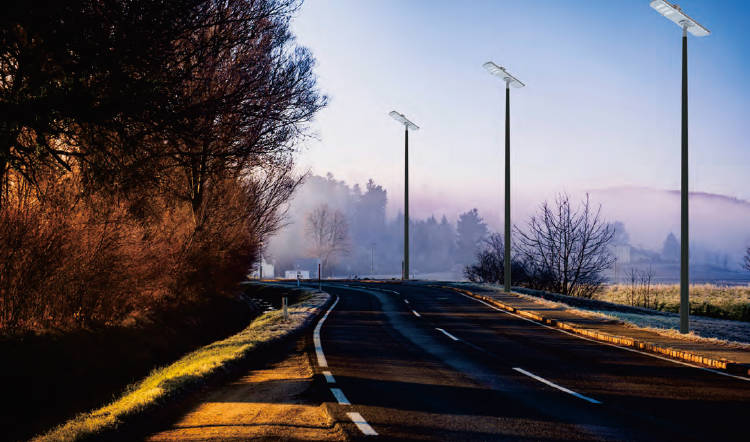
What is Solar LED Street Light?
A solar LED street light is a standalone, off‑grid outdoor lighting system that combines four core modules:
- Solar panel: Converts sunlight into DC electricity during the day.
- Rechargeable battery: Stores energy for nighttime operation (LiFePO4 lithium batteries now occupy over 85% of new installations globally, replacing short‑life lead‑acid products).
- LED luminaire: Delivers high‑efficiency, long‑life illumination with a service life of over 50,000 hours.
- Smart controller: Manages charging, discharging, motion‑sensor dimming, and overcharge protection.
Two designs dominate the global market by shipment volume:
- All‑in‑one integrated type: Compact, fast to install, accounting for 60.3% of all new solar LED street light deployments in 2025; widely adopted in municipal roads, rural villages and parking lots.
- Split type: Separated solar panel and lamp head, higher power output (60W–150W), taking up the remaining 39.7% market share for highways and high‑illuminance industrial zones.
Why choose Solar LED street lights?
The solar lights harness the power of the sun, a virtually inexhaustible energy source, to provide efficient and reliable illumination. Unlike traditional street lights that rely on grid-supplied electricity, solar LED street lights operate independently, reducing the strain on the power grid and minimizing the risk of power outages. This makes them particularly attractive for remote areas where grid connection is either difficult or costly.
Environmental Awareness
One of the most significant drivers of the solar LED street light market is the growing environmental awareness among consumers and governments. With the increasing global concern over climate change and air pollution, there is a strong push towards clean energy alternatives. Solar LED street lights produce zero greenhouse gas emissions during operation, making them a sustainable choice for lighting public spaces.
Cost – Efficiency
In the long run, solar LED street lights are a cost-effective option. Although the initial installation cost may be higher than traditional street lights, the savings on electricity bills and maintenance costs over time are substantial. These lights require minimal maintenance as they have no moving parts, and the LEDs have a long lifespan, reducing the need for frequent replacements.
Technological Advancements
Continuous technological advancements have also played a crucial role in the growth of the solar LED street light market. Improvements in solar panel efficiency, battery storage technology, and LED lighting performance have made these systems more reliable and efficient. For example, the development of high-capacity lithium-ion batteries has enhanced the energy storage capabilities of solar LED street lights, allowing them to provide illumination even during extended periods of low sunlight.
Potential market for solar street light in future 10 years
Based on 2026 industry reports from Emergen Research and PW Consulting, the global solar LED street lighting market carries clear quantitative growth signals:
- 2025 Base Market Scale: The total global market value reached USD 8.53 billion; total worldwide export shipments hit 6,599 units from June 2024 to May 2025, rising 18% year‑on‑year versus the prior 12‑month cycle (Volza global customs trade database).
- Long‑term Forecast Growth: The market will expand at a 9.1% compound annual growth rate (CAGR) from 2026 to 2035, exceeding USD 20.54 billion by 2035. Alternative research from PW Consulting predicts a higher 13.48% CAGR, pushing market value to USD 21.23 billion by 2032.
- Application Segment Breakdown: Highway and roadway lighting contributes 50.3% of total market revenue, followed by rural village public spaces (27.1%), commercial parking lots (14.6%), and scenic parks & industrial zones (8.0%) in 2025.
Main market for solar led street lights
- The Asia-Pacific region is a dominant player in the global solar LED street light market (Largest Market, USD 4.11 billion, 47.0% global share).
India, Vietnam, the Philippines and Bangladesh are the top four importing nations in Asia; Asia‑Pacific’s market CAGR will stay at 12–15% from 2026 to 2035.
70% of Chinese cities and 65% of Indian towns have adopted solar LED street lights for new public road construction.
- Middle East & Africa (Fastest-Growing Region, USD 1.81 billion, 20.7% share)
High solar irradiation and severe grid shortages push rapid growth; all‑in‑one low‑power solar lights make up 75% of local purchases, supported by World Bank rural infrastructure grants.
- Europe (USD 1.32 billion, 15.1% share)
Strict energy efficiency standards drive replacement demand; EU buyers prioritize CE, RoHS and recyclable lithium battery compliance, with smart connected products taking over 40% of regional sales.
- North America(USD 1.07 billion, 12.2% share).
The United States and Canada are witnessing a growing demand for solar LED street lights
Demand centers on highways, remote tribal zones and commercial parking lots; Lighting‑as‑a‑Service (LaaS) leasing models cover 38% of municipal procurement to solve upfront capital pressure.
- Latin America (USD 439.4 million, 5.0% share)
Brazil, Mexico and Peru lead regional consumption, with infrastructure investment rising after 2024 national renewable energy policy upgrades.
Challenges and Opportunities
Challenges
Despite the significant growth potential, the solar LED street light market faces several challenges. One of the main challenges is the high initial cost of installation, which can be a barrier for some developing countries and local governments with limited budgets. Additionally, the performance of solar LED street lights can be affected by factors such as weather conditions and geographical location. In regions with low sunlight hours or frequent overcast skies, the efficiency of the solar panels may be reduced, leading to lower energy production.
Opportunities
However, these challenges also present opportunities for innovation and growth. For example, the development of more cost-effective manufacturing processes and the use of alternative materials can help reduce the initial installation cost. Moreover, the integration of smart technologies, such as sensors and remote monitoring systems, can enhance the performance and efficiency of solar LED street lights. These technologies can adjust the lighting intensity based on the time of day, traffic flow, and ambient light conditions, further reducing energy consumption.
The Future Outlook
The future of the international market for solar LED street lights looks extremely promising. As technology continues to evolve and the cost of production decreases, the adoption of these lights is expected to accelerate. The integration of solar LED street lights with other smart city technologies, such as energy management systems and traffic control systems, will create new opportunities for growth and innovation.
In conclusion, the solar LED street light international market is a vibrant and rapidly expanding sector. It offers a sustainable, cost-effective, and efficient solution for lighting public spaces, and its potential to transform the global energy landscape is immense.