
Why Are LED Light Sources the First Choice for High-Mast Lamps?
1. Boasts Excellent Lighting Performance, Delivering Sufficient Brightness, Wide Illumination Range and Uniform Light Distribution
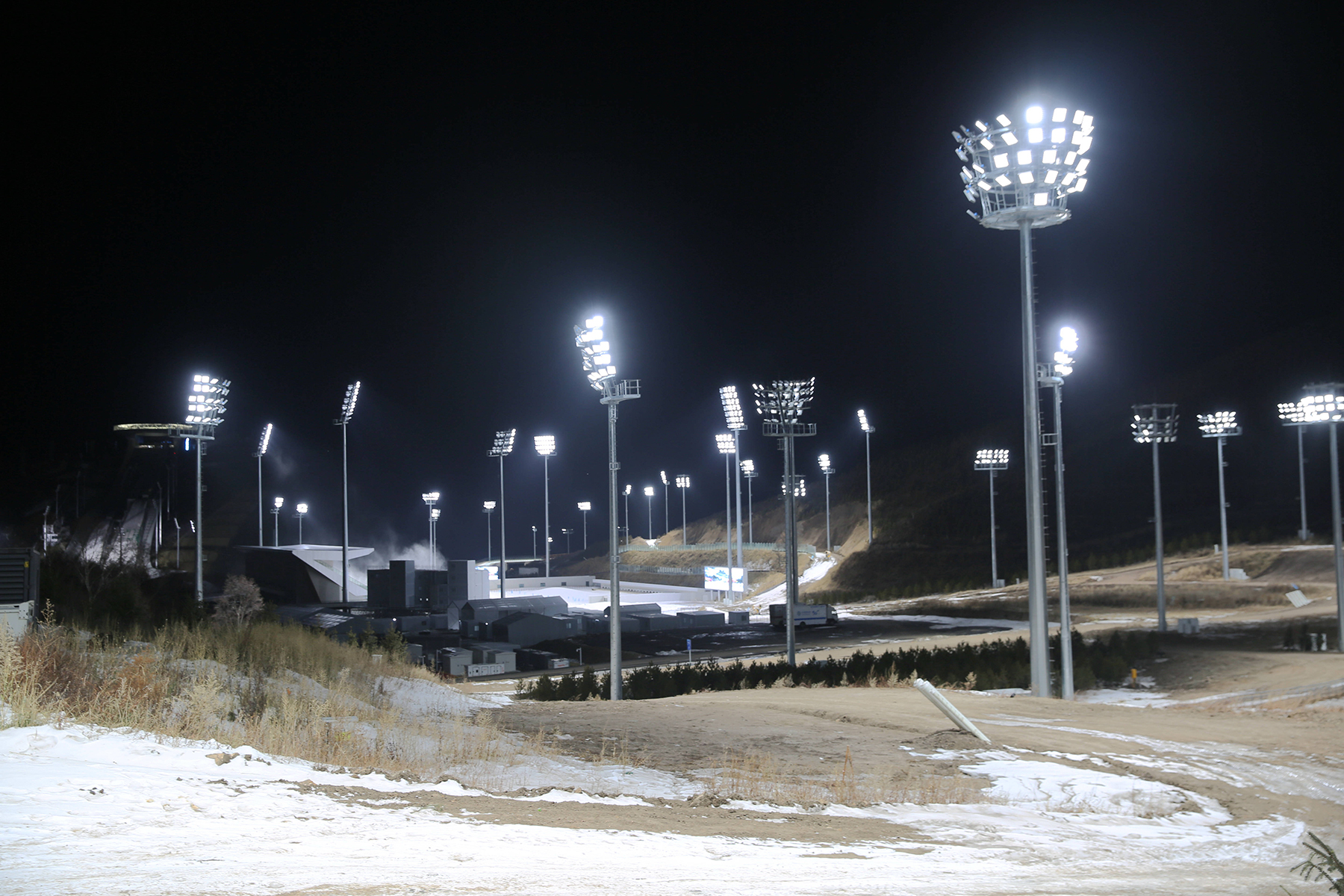
The core requirement of high-mast lamps is to illuminate large spaces, and the high luminous efficacy of LED light sources (up to 150-190 lumens per watt) can easily meet this demand.Take a 30-meter high-mast lamp as an example: equipped with a 500W LED light source, it can achieve an illumination radius of 80-100 meters with uniform light distribution. The brightness difference between the edge and central areas is minimal, avoiding the issue of “overly bright centers and dim edges”.Whether it is for crowded activity zones in urban squares or competition venues in sports stadiums, it delivers a clear, comfortable lighting environment and reduces visual fatigue.
2. Greater Durability: Robust, Long-Lasting and Low-Maintenance
Outdoor high-mast lamps are exposed to wind, rain, high temperatures and freezing cold all year round, which puts an enormous test on the weather resistance of light sources.LED light sources contain no fragile components such as filaments or glass, boasting a more robust structure. They can withstand extreme temperatures ranging from -30℃ to 60℃, as well as severe weather conditions like heavy rain and sandstorms.Meanwhile, their service life is 3–5 times longer than that of traditional light sources, significantly reducing the replacement frequency of high-mast lamps. As we all know, the maintenance of high-mast lamps requires lifting by professional equipment, which is costly and time-consuming each time. The long service life of LED light sources directly reduces the pressure of later operation and maintenance.
3. Higher Cost-Effectiveness: Energy-Saving & Cost-Controllable
From a long-term usage perspective, the energy-saving advantages of LED light sources can bring significant cost savings.Compared with traditional high-pressure sodium lamps, LED light sources can reduce energy consumption by more than 50%. Take 100 sets of 500W high-mast lamps as an example: operating 10 hours a day, the annual electricity cost of LED light sources is about 18,250 yuan (calculated at a residential electricity price of 0.5 yuan/kWh), while that of traditional light sources amounts to 36,500 yuan. This translates to nearly 50% in annual electricity cost savings.
In addition, the price of LED light sources has become increasingly affordable in recent years. Coupled with their long service life and low-maintenance features, their total life-cycle cost is far lower than that of traditional light sources, making them the cost-effective choice for high-mast lamps.
Three Mainstream Types of LED Light Sources: Meeting the Lighting Needs of High-Mast Lamps in Different Scenarios
1. Standard High-Power LED Light Source: The All-Round Choice for General Applications
Most high-mast lamps on the market adopt standard high-power LED light sources (typically ranging from 100W to 500W), which are ideal for general scenarios such as urban squares, medium-sized sports stadiums, and ordinary parks.
Its core advantage lies in well-balanced adaptability: it features stable luminous efficacy to meet the lighting needs of most scenarios; it supports simple installation and can directly replace the lamp heads of traditional light sources; it is relatively affordable, striking a perfect balance between performance and cost.
For example, a high-mast lamp in an urban square equipped with a 300W standard LED light source can cover a radius of 50–60 meters, satisfying the lighting demands of people walking and engaging in activities, while avoiding excessive energy consumption.
2. Color Temperature Adjustable LED Light Source: The Ambiance Creator for Atmosphere-Focused Scenarios
For high-mast lamp applications that prioritize scene ambiance—such as commercial plazas, cultural tourism scenic spots, and theme parks—color temperature adjustable LED light sources offer distinct advantages.
They not only retain the high brightness and long service life of standard LED light sources, but also allow color temperature adjustment on demand (freely switchable from 3000K warm yellow light to 6000K cool white light). During daytime or lively events, switch to 5000K–6000K cool white light to create a bright and dynamic atmosphere. For nighttime leisure periods or festive scenes, switch to 3000K–4000K warm yellow light to deliver a cozy and soft feeling.
Take high-mast lamps in cultural tourism scenic spots as an example: during nighttime light shows, adjusting their color temperature to coordinate with surrounding landscape lights can significantly enhance tourists’ visual experience.
Smart-Driven LED Light Source: The Efficient Steward for Complex Scenarios
For complex high-mast lamp applications with demanding requirements for intelligent management and precision lighting—such as highway service areas, large-scale logistics parks, and airport peripheries—smart-driven LED light sources are the superior solution.
Equipped with a built-in smart driver chip, they support remote control (e.g., brightness adjustment via mobile APPs or backend management systems) and can also provide real-time feedback on operating status (including voltage, temperature, and fault alerts), facilitating remote monitoring and maintenance for managers.
Take high-mast lamps at highway service areas as an example: brightness can be adjusted based on traffic volume—during daytime with low traffic flow, dim the brightness to 50% for energy conservation; at night with heavy traffic, boost it to 100% to ensure safety; in case of malfunctions, the system can issue timely alerts to prevent disruptions to traffic caused by insufficient lighting.
In addition, smart-driven LED light sources support scheduled on/off and time-segmented dimming functions, further optimizing energy consumption and operational efficiency