
【Abstract】This article analyzes the technological advancements in LED lighting products, including the performance optimization of 5656 and 3838 series LEDs, the technical parameters of outdoor lighting products, and the development of energizing lighting and Dark Sky-compliant lighting solutions. It also explores the industry’s shift toward ecological protection and human-centric lighting design, providing insights into the future direction of LED lighting technology.
Introduction
LED lighting technology has evolved rapidly in recent years, driven by the dual demands of performance improvement and sustainable development. Product innovation focuses on enhancing luminous efficacy, reducing production costs, and adapting to specialized application scenarios such as outdoor lighting and energizing lighting. Meanwhile, the Dark Sky movement has introduced strict standards for lighting design to mitigate light pollution, pushing the industry to balance functionality with ecological protection. This paper examines the latest product technologies and future development trends in LED lighting based on technical presentation materials, with a focus on product performance data and compliance with Dark Sky standards.
Product Technology Advancements
5656 Series LED Upgrade
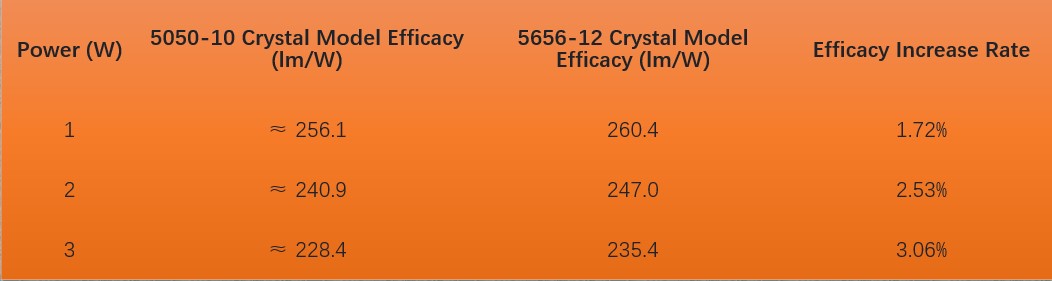
Notes:
- The efficacy data of the 5050-10 model is calculated based on the formula:
5050-10 Efficacy=1+Increase Rate5656-12 Efficacy
- All data is measured under the same test conditions to ensure comparability.
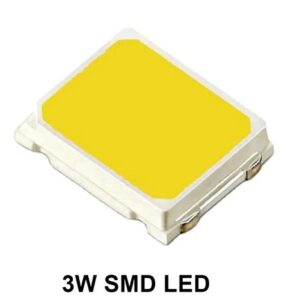
The 5656 series LED represents a key upgrade in high-power lighting products, with significant improvements in luminous efficacy across 1W, 2W, and 3W power levels. Compared with the 5050-10 crystal model, the 5656-12 crystal model achieves a 1.72% increase in efficacy at 1W (reaching 260.4 lm/W), a 2.53% increase at 2W (247.0 lm/W), and a 3.06% increase at 3W (235.4 lm/W). The optimized 5656 structure not only boosts luminous efficiency but also enhances thermal performance and structural stability, making it suitable for high-power lighting applications.
3838 Series LED Innovation

The 3838 series LED is designed as a replacement for the 2835 (3030) series, with a 2.82% improvement in luminous efficacy. Its core advantages include cost reduction in brackets and glue usage, as well as a lightweight design. The 3838 series uses the same chip configuration (chip2235*8) as the 5050 series, ensuring compatibility while achieving better cost-effectiveness. Currently in the trial production stage, this series is expected to become a mainstream product in medium-power lighting applications due to its performance and cost advantages.
Outdoor Lighting Product Portfolio
For outdoor lighting applications, a range of 3535 series products (3W, 6W, 10W) and the LX3535 model are developed with diverse chip and substrate configurations. For example, the 3535-3W (SA40mil, Al₂O₃+Ag) achieves 185 lm/W, while the LX3535 (LDR60, AlN+Ag+LDom) reaches 250 lm/W with a 10S rating. These products are optimized for outdoor environments, featuring high thermal conductivity substrates (AlN, Al₂O₃) and advanced chip technologies (XTE, XPG3, XPL), ensuring stable performance in harsh outdoor conditions.
Future Development Trends
Energizing Lighting vs. Conventional Outdoor Lighting
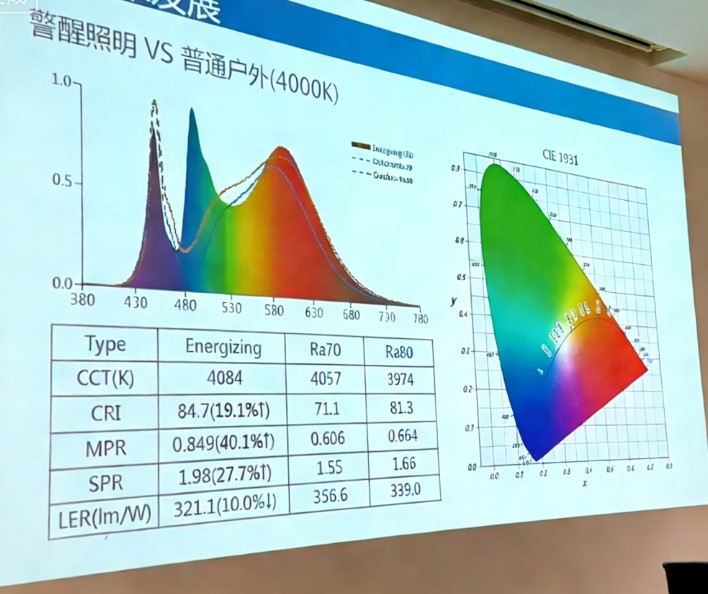
Energizing lighting (or “alert lighting”) is a new direction in human-centric lighting, designed to enhance visual alertness compared with conventional outdoor lighting. At 3000K, energizing LED achieves a 14.3% higher CRI (80.8) and a 37.5% higher MPR (0.612) than outdoor Ra70 lighting, with a 23.8% increase in SPR (1.51). At 4000K, the CRI of energizing lighting rises to 84.7 (19.1% higher than Ra70), and MPR reaches 0.849 (40.1% higher). Although its LER (luminous efficacy of radiation) is slightly lower (8.6% at 3000K, 10.0% at 4000K), the improved visual performance makes it ideal for applications such as road safety lighting and public area illumination.
Dark Sky Compliance and Light Pollution Mitigation
The Dark Sky movement has established two authoritative standards: DarkSky Approved (led by the International Dark-Sky Association) and Chile’s MMA Standard (enforced by Chile’s Ministry of the Environment for astronomical protection). The DarkSky Approved certification follows five core principles: usefulness (light directed at specific targets), directionality (full shielding of light sources), low brightness & warm color (color temperature ≤3000K, 10% dimming support), controllability (smart control for on-demand operation), and ecological compatibility.
To comply with Dark Sky standards, LED products must control blue light emissions strictly: ≤1% blue light ratio in core astronomical/biodiversity protection zones (Zone A) and ≤7% in general protection zones (Zone B). Manufacturers are required to submit full spectral power distribution reports and use narrow-spectrum red or amber LEDs instead of white light in sensitive areas. Technical solutions such as the “Sky Glow %blue <1%” and “<2%” schemes have been developed, with CCT values as low as 1800K-1900K and CRI ratings of 62-72, balancing astronomical protection with basic lighting functionality.
Conclusion
LED lighting technology is advancing toward higher efficacy, cost reduction, and specialized application scenarios. The 5656 and 3838 series products demonstrate significant performance improvements, while outdoor lighting solutions are optimized for durability and efficiency. Future development will focus on human-centric energizing lighting and Dark Sky-compliant design, addressing the need for reduced light pollution and ecological protection. Compliance with Dark Sky standards, including blue light control and warm color temperature requirements, will become a key competitive factor for LED manufacturers. As the industry continues to innovate, the integration of smart control, spectral optimization, and sustainable design will shape the next generation of LED lighting products.