

In many lighting projects, optical parameters are often the focus of design, selection and evaluation, such as luminous efficacy, light distribution, UGR, and color rendering index. However, in fact, problems such as insufficient brightness at the end of the led strip, unstable brightness, abnormal flickering of the driver, or premature failure often point to another underestimated factor—voltage drop.
Voltage drop is not a product parameter, nor is demonstrated in the data sheet, but it profoundly affects:
- Stable operation of LED lighting fixtures;
- Brightness consistency and color reproduction of the LED strip system;
- Thermal stress and long-term lifespan of the driver;
- Energy efficiency and safety of the entire lighting system;
From low-voltage light strip to high-voltage AC system, from passive power supply to active compensation drive circuits, voltage drops not only cause visible brightness and color shift problems, but may also lead to thermal out of control and trigger electrical protection mechanisms inside the driver, ultimately affecting the lifespan of the entire lamp.
This article will focus on LED lighting systems, deeply analyzing the sources, impact paths, manifestations, and failure mechanisms of voltage drop, and providing engineering solutions for different system architectures.
01 What is voltage drop? How does it affect a light bulb?
In a circuit, when current flows through a wire, the wire’s own resistance will “eat up” a portion of the voltage, resulting in a difference between the power supply output voltage and the voltage received by the lamp.
This difference is called voltage drop. Key factors affecting it include:
- Wire length: The greater the distance, the greater the voltage drop.
- Wire thickness: The thinner the wire, the greater the resistance.
- Current flow: High-current systems experience more significant voltage drops.
- Conductor material: Copper wire is superior to aluminum wire.
You can think of the entire circuit as a water pipe: water pressure represents voltage, and water flow represents current. If the pipe is very thin and long, and a lot of water is flowing, then the water pressure from the tap will definitely not be enough—this is the physical intuition of voltage drop. For LED lighting, the consequences of insufficient water pressure are not trivial.:
- Low-voltage LED strips: The ends darken and turn red, resulting in color distortion.
- High-voltage lighting fixtures: High-load compensation of the driver can cause overheating, flickering, or even premature burnout.
Moreover, it’s not just about whether it’s “bright or not,” it could also be about “whether one can work.”。
02 Where does the voltage drop come from? It seems simple, but it is highly systematic.
The essence of voltage drop is that when current flows through a conductor with resistance, part of the voltage is “eaten up” along the way. Although in physics it is simply V=IR, in actual lighting systems it is often a dynamic manifestation resulting from the superposition of multiple factors. Common influencing factors:
- Line length: The longer the line, the greater the resistance and the more significant the voltage drop.
- Cable specifications: The thinner the wire (smaller cross-sectional area), the greater the resistance.
- Load current magnitude: The higher the system power and the higher the current, the more significant the voltage drop.
- Conductor material: Copper is superior to aluminum, resulting in a smaller voltage drop for the same specifications.
- System voltage level: Low-voltage systems are more sensitive to voltage drop (see Part 3 for details).
Nonlinear heating effect: Although voltage drop is linearly related to current, line heating increases exponentially. That is, when current increases by 50%, voltage drop only increases by 50%, but the line’s heating power will rise to 2.25 times of its original value, easily leading to the following consequences.:
- Excessive wire temperature rise
- Overheating, discoloration, or even melting of wiring terminals
- Aging of the input of the light fixture
- Driver input voltage drops out of its operating range, triggering protection mechanism or causing burnout
These “invisible faults” are often discovered when the lights flicker, reduce brightness, or premature fail to work, when the window for prevention has often passed.

Image: Inconsistent light output brightness caused by voltage drop in the LED strip (Image from the internet)
03 Low-voltage DC vs. high-voltage AC: System architecture determines sensitivity.
LED lighting systems can be broadly divided into two categories::
- Low-voltage DC system (LVDC): such as 12V/24V LED strips
- High-voltage AC systems (HVAC): such as 220V AC powered lighting fixtures (downlights, panel lights, bulbs, etc.)
These two types of systems have completely different response mechanisms to voltage drops: one is “direct dimming,” and the other is “driver strain.”
3.1 Low-voltage system: Why does the LED strip always get dimmer as you move through it?
Taking 60W power as an example:
- 12V system current:60 / 12 = 5 A
- 220V system current:60 / 220 ≈ 0.27 A
Under the same circuit conditions, the current in a low-voltage system can be more than 15 times that of a high-voltage system, and since the voltage drop is directly proportional to the current, this leads to:
- Large voltage drop:A low-voltage system might drop 2V, which is already 16%–20% of the total voltage.
- Percentage has a greater impact:If a 12V LED strip cuts 2.5V, the ends may dim or become discolored.
In addition, RGB light strips may exhibit color shift due to inconsistent Vf values of the three color chips (blue and green turn off first, leaving only red), which is a typical manifestation of voltage drop mismatch.
3.2 High-voltage system: The driver is “struggling”
Most 220V LED luminaires have a built-in SMPS (switching power supply) driver, which has a certain input voltage adaptive capability (such as 100–240V range).
Performance characteristics:
- When there is a slight voltage drop: the driver will actively adjust the switching duty cycle to stabilize the output current.
- When the voltage drop is too deep: Undervoltage protection (UVLO) is triggered, and the entire lamp suddenly shuts off.
- Prolonged exposure to edge conditions: Increased driver load, shortened lifespan, and even MOSFET thermal failure.
The advantage of this mechanism is that users cannot see the change in brightness, but the system risks are hidden inside, which places higher demands on maintenance personnel and designers.
04 What exactly does a voltage drop change? From “lights dimming” to “system failure”?”
Voltage drop doesn’t directly cause a light to “go out,” but it gradually weakens the stability and consistency of the lighting system in a systematic way. We can understand its impact path from three levels:
4.1 Visual manifestations: inconsistent brightness, darkening, color cast
- The light strip gets dimmer as you move around.
Commonly found in 12V/24V LED strip projects, it is bright at the beginning and turns reddish or discolored at the end, especially noticeable in RGB systems. The cause is insufficient chip input voltage due to voltage drop, and uneven Vf (forward voltage drop) causes color difference. - Inconsistent brightness in multiple downlights/spotlights
Within the same circuit, lights closer to the power supply are brighter, while those farther away are dimmer, resulting in poor luminous flux consistency and affecting the overall visual effect and design fidelity. - Localized flickering in long-distance power supply
When the voltage is at the edge of the driver startup threshold, it will trigger periodic startup/shutdown, which will be visible to the user as flickering.
These visual changes not only degrade lighting quality but are also easily misdiagnosed as “lamp quality issues” or “driver instability,” while overlooking systemic power supply problems.
4.2 Driver Response: from compensation to overheating to damage
For high-voltage LED lighting fixtures (such as downlights, spotlights, and industrial lamps), the main “victims” of voltage drop are actually the power supply. It manifests as:
- Continuous high-load operation: In order to maintain constant current output, the driver actively increases the on-time of the switching transistor, resulting in increased temperature rise.
- Operating in a critical state: When the input voltage is close to the lower limit of startup, occasional flickering may occur, or even undervoltage protection may be triggered.
- Long-term damage accumulation: Core components such as MOSFETs and electrolytic capacitors are under high stress for extended periods, resulting in a significantly shortened lifespan.
In short: the voltage drop won’t burn out the lamp, but it will burn out the driver.
4.3 System stability vulnerabilities: difficult to detect, difficult to troubleshoot, and with serious consequences.
- Not visible during construction phase
During initial installation and testing, the light should be on without any obvious abnormalities. Problems often only surface several months after the device has been in use. - Difficult to locate during maintenance
The light fixtures are clearly working, and the drivers have been replaced, but the lights still flicker intermittently or the brightness is unstable. The cause, however, lies in the voltage drop across the line, which is located tens of meters away. - High maintenance costs
If the fault points are widely distributed, it often requires rewiring or replacing with larger cross-section cables, which is far more expensive than the initial investment.
In engineering design, voltage drop is neither the responsibility of the lighting fixture supplier nor the responsibility of the control system supplier. It is often overlooked in the design or the construction team selects the wiring based on experience, making it difficult to define responsibility and prevent problems.
05 Voltage Drop Response Strategies: From “Verification” to “Redundant Design”
How can we avoid or reduce the impact of voltage drop during the design and construction phases? Here are some common, actionable strategies:
5.1 Voltage drop calculations must be performed before selecting a cable.
Use Ohm’s law or a lookup table to estimate the voltage drop, ensuring that the voltage at the end remains within the normal operating range of the equipment.
Voltage drop calculation formula (single-phase AC):
Among them:
ΔV:voltage drop(V)
L:Cable length(m)
I:Current(A)
ρ:Conductor resistivity(Copper is 0.0175)
A:Conductor cross-sectional area(mm²)
Recommendation: The total voltage drop should be kept within 3% to 5% of the system voltage.
5.2 Plan ahead for segmented power supply or remote compensation
- LED strip systems should preferably use segmented power supply or dual-ended power supply.
- Large-scale installations can adopt a centralized power supply + constant voltage line + local step-down module architecture.
Drivers with remote voltage feedback functionality can accurately compensate for line losses.
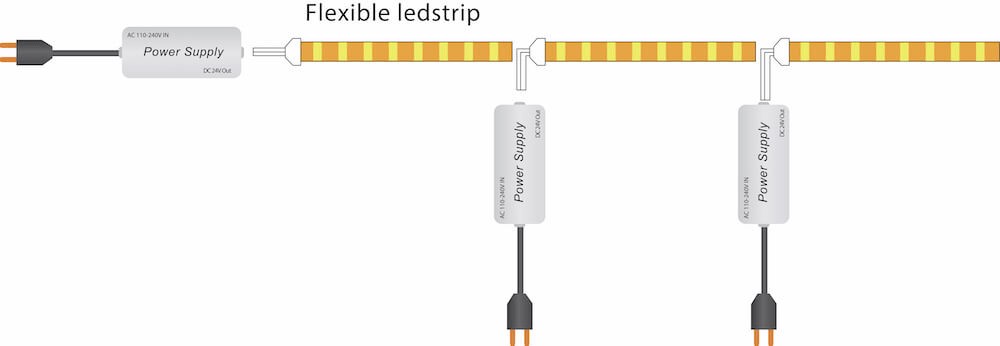
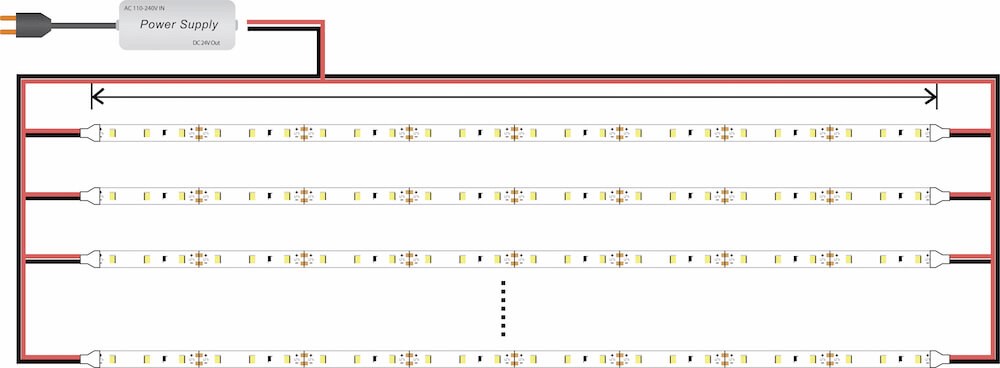
Image: Segmented power supply and dual-ended power supply for LED strips (Image from the internet)
5.3 Redundancy is not waste, but rather a form of system insurance.
- Increase the wire diameter appropriately (e.g., from 1.5mm² to 2.5mm²).
- When using low voltage for short distances, 24V is recommended over 12V.
- Line layout should consider “loop resistance” rather than just distance.
Voltage drop is not a question of “whether it exists,” but rather the boundary of “whether it has caused a problem.” The more rigorous the engineering design, the higher the system stability.
06 A lighting system is not a patchwork project, but a complete engineering project.
In the era of LED lighting, we are accustomed to pursuing “visible” light quality indicators such as color rendering index, color temperature consistency, low UGR, and beam control, and we also like to emphasize “advanced” concepts such as optical design, intelligent control, and circadian rhythm health. However, the more these systems improve their capabilities, the more we must not overlook the fundamental engineering factors that fall under the category of “power distribution”.
Voltage drop is the most representative example: it doesn’t appear in illuminance calculations or appear in the luminaire parameter table, yet it can silently lower the overall system’s performance baseline. The larger the project, the more complex the circuits, and the longer the terminal distance, the more likely voltage drop is to become a “hidden killer” that cannot be quickly identified.
It makes good products “unusable”, causes stable drives to inexplicably stop working, and causes control systems to exhibit seemingly “unexplainable” malfunctions. These problems can actually be avoided in the early stages of design—provided that we are willing to treat the lighting system as a complete engineering system, rather than just a combination of light fixtures and controllers.
A truly stable, efficient, and controllable lighting system is never just a superposition of light, but a synergistic system of light, electricity, and control. Only by valuing the logic of “electricity” can we truly uphold the quality of “light”.