
Recently, a joint research team comprising Yancheng Teachers University, the Institute of Semiconductors of the Chinese Academy of Sciences, Xiamen University, and other institutions has made significant progress in improving the luminous efficiency of InGaN-based green Mini LEDs.
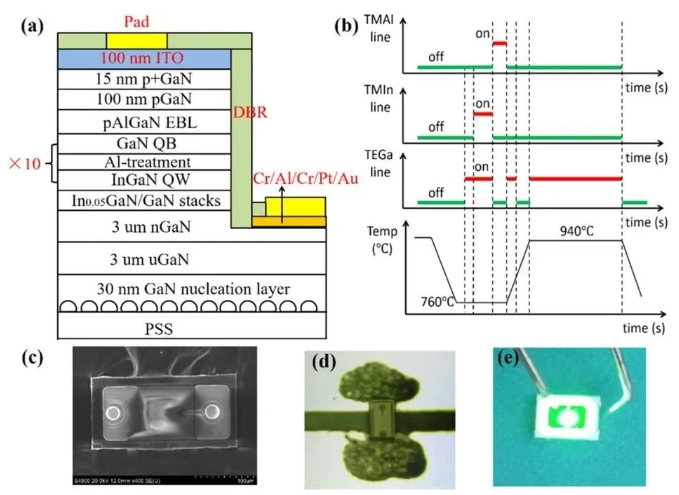
Image source: Applied Physics Letters
During the quantum well growth stage, the team introduced an aluminum treatment process, resulting in a green Mini LED that achieved a peak external quantum efficiency (EQE) of 65.0% and a wall-plug efficiency (WPE) of 60.1%. The related research findings have been published in the American academic journal Applied Physics Letters.
The team adopted a novel aluminum treatment process, in which trimethylaluminum (TMAl) was briefly introduced after growing each InGaN quantum well layer, forming an ultra-thin AlGaN protective layer on the quantum well surface. This approximately 0.5nm-thick film reduces defects during crystal growth, making the quantum well structure flatter and more stable, thereby enhancing overall crystal quality.
Microstructural analysis revealed a significant reduction in material defects after the aluminum treatment. Optical tests also confirmed that electrons and holes complete the luminescence process more rapidly, indicating a notable improvement in material luminous efficiency.
These improvements were directly reflected in the device performance. The 520nm flip-chip green Mini LED developed by the research team achieved an external quantum efficiency of up to 65% and a wall-plug efficiency of 60.1% under low current, setting a new record for the highest publicly reported efficiency of InGaN green LEDs.
Even under conventional operating currents (20 A/cm²), the device maintained high efficiency, significantly outperforming traditional green LEDs. Additionally, the luminescence wavelength of the device remained more stable with varying currents, indicating that the new structure effectively mitigates the piezoelectric field effect, making the luminescence more reliable.
Importantly, this technology is based on low-cost patterned sapphire substrates (PSS), making it suitable for practical mass production. Researchers believe that the novel aluminum treatment process not only improves material strain and interface quality but also enhances indium absorption efficiency, making green LED luminescence brighter and more stable.
(Reprinted from www.ledinside.cn)